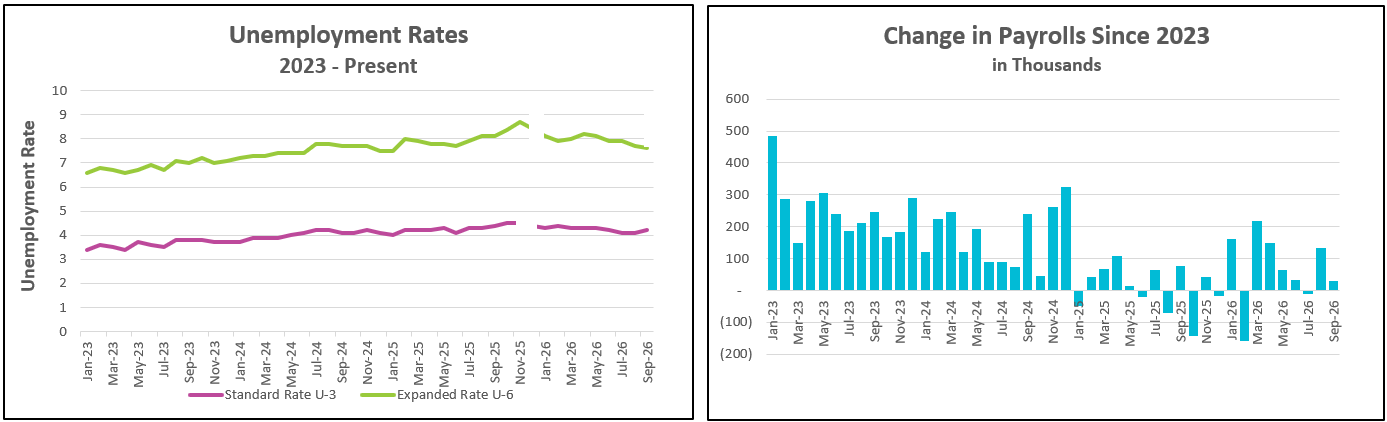
Key takeaways from the Bureau of Labor Statistics (BLS) report, The Employment Situation – September 2026, include:
A less-than-expected 29,000 people were added to payrolls in September. This figure is significantly below the 2026 monthly average of 68,000 but remains well above the 2025 average of only 9,700. The Bureau of Labor Statistics (BLS) also revised its payroll figures for July and August: July’s numbers were reduced by 31,000, resulting in 10,000 fewer people holding jobs, while August’s payrolls were revised lower from 166,000 to 133,000.
The unemployment rate increased slightly to 4.1%. These adjustments reinforce the emerging trend of fewer payrolls added and a gradually rising unemployment rate, indicating a cooling labor market. Between January and July, the labor force declined by nearly 2.8 million people as baby boomers retired and many workers were deported. The smaller labor force helped keep unemployment low, since only those working or actively seeking work are counted. The participation rate also fell during the same period. But there have been recent signs of improvement: since July, both the labor force and the participation rate have edged higher, suggesting that more people are returning to the labor force. But not everyone reentering the workforce has found jobs – thus the unemployment rate has drifted higher.
More workers have helped prevent the labor market from adding to inflationary pressures. Wage growth has cooled: average hourly wages rose just 3% over the past 12 months, the smallest increase since May 2021 during the COVID pandemic. For most workers, wage increases have failed to keep up with inflation for several months, putting additional strain on household budgets. As household budgets become more strained, there’s a risk that consumers will pull back, potentially slowing economic growth. Recent surges in gas prices, the ongoing war with Iran, and an overall climate of uncertainty have pushed the University of Michigan’s consumer sentiment index to its lowest level in four months. When people are worried, they tend to tighten their wallets.
The unemployment rate among African Americans jumped a concerning 1% in September, reaching 7%. This rate has been climbing recently and may signal trouble ahead, as black workers are often the first laid off and last hired during downturns. Additionally, payrolls for temporary workers fell by 10,900—a troubling sign, since temporary jobs are typically cut first when businesses anticipate a slowdown.
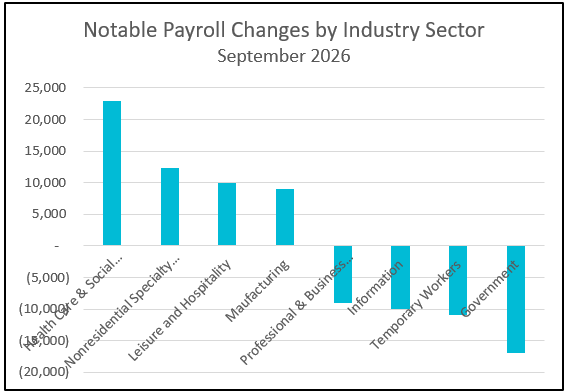
Sector Highlights
The Federal Reserve recently raised interest rates to address inflation, which generally reduces the demand for labor by dampening economic activity. Given the cooling job market, this report may support delaying another rate hike when the Fed meets later this month.
Finally, employers appear to be increasingly cautious as the war with Iran, Trump’s trade policies, and tight immigration restrictions generate economic uncertainty. History shows that consumers tend to cut back on spending in uncertain times, further contributing to the cautious mood in the labor market.
The coming months will be critical in determining whether the labor market can regain momentum—or if these warning signs point to deeper economic challenges ahead. Policymakers are anxiously awaiting the CPI, which will be released on October 14th.