Key takeaways from the Bureau of Labor Statistics (BLS) report, The Employment Situation – August 2026, include:
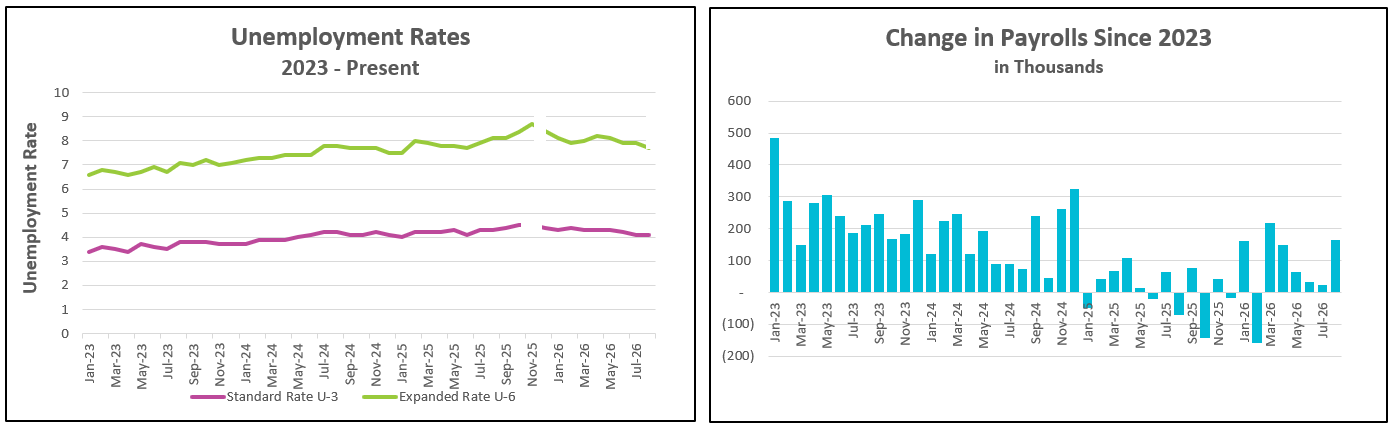
The U.S. labor market continued to demonstrate surprising strength in August, powering through uncertainty related to the war in Iran, persistent inflation, and concerns about the broader economy. Hiring accelerated significantly, far exceeding the twelve-month average of 32,000 workers. Job gains were widespread, with leisure and hospitality, construction, manufacturing, health care, and local government education all adding employees.
The unemployment rate remained unchanged at 4.1%, a healthy rate considering that more than 600,000 people entered the workforce. The labor-force participation rate increased to 61.6%, marking a sharp reversal of the downward trend that had continued since November 2025. August’s increase was an encouraging development since restrictive immigration policies, reductions in the federal workforce, and an aging population have contributed to a contraction in the labor force. However, it is important to note that the civilian labor force is slightly smaller than a year ago, and participation is 0.5 percentage points below its January level.
A broader measure of unemployment improved. The U-6 unemployment rate, which includes unemployed people, those working part-time for economic reasons, and those marginally attached to the labor force, fell from 7.9% to 7.7%. The decline suggests that more people are finding work, even if some are not yet obtaining full-time employment.
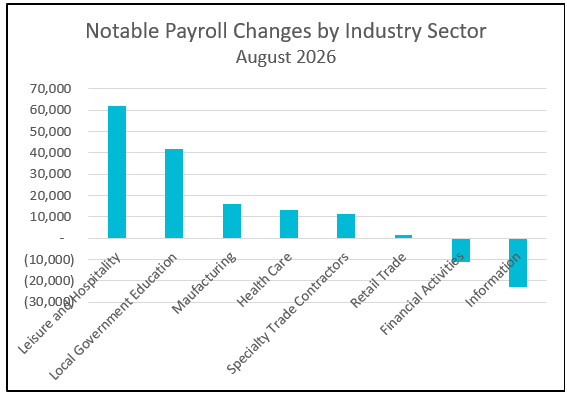
Local government education posted one of the strongest gains, adding 42,000 jobs. The increase reflects teachers returning to work after summer contracts expired. That rebound followed a decline of 50,000 local education jobs in July, illustrating how seasonal patterns can create substantial month-to-month volatility in the data.
Manufacturing continued its upward trend, adding 16,000 jobs in August. Nonresidential specialty contractors added 8,000 jobs, reflecting strong demand associated with the construction of data centers and other artificial-intelligence infrastructure. 58,000 more workers are employed in manufacturing jobs than in December 2025.
Healthcare employment increased by 13,000 workers, although that gain was considerably weaker than the industry’s twelve-month average of 32,000.
The information sector remained a significant source of weakness. Employers cut 23,000 jobs in August, bringing the sector’s losses to 115,000 over the past twelve months. Financial services employment also continued to decline, falling by 11,000 workers. Artificial intelligence has replaced or reduced the need for many traditional positions in both the information and financial services sectors.
These losses highlight the uneven effect of artificial intelligence on the labor market. AI is eliminating jobs in certain information and financial services occupations while simultaneously creating demand in industries that support its expansion. Over the past year, employment in goods-producing industries grew by 0.7%, compared with 0.6% growth in service industries. That difference likely reflects the boom in AI-related manufacturing, data centers, construction, and specialized infrastructure.
It is tempting to credit President Trump’s tariff policy with the recent increase in manufacturing employment. However, that conclusion would be premature. The country has fewer manufacturing jobs today than when Mr. Trump took office, and the latest gains appear more closely connected to the expansion of AI-related industries than to tariffs alone. Manufacturing employment could benefit in the future, however, as companies follow through on plans to bring production back to the United States. According to an article in The Economist, companies including Ford, General Motors, and Honda have announced plans to increase domestic manufacturing.
Wage growth remains a more complicated part of the report. Average weekly wages have increased 3.1% since the beginning of the year, the slowest pace since the second quarter of 2021. That increase is below the inflation rate: in July, the Federal Reserve’s preferred measure of inflation, the personal consumption expenditures price index, showed inflation of 3.7%. However, the drop in real income was partially offset by higher earnings from a longer workweek. Average weekly earnings have increased 3.6% since last August.
The rise in total income should help support consumer spending in the coming months. Nevertheless, the increase in total real weekly earnings is negative, making it more difficult for families to meet their budgets. Even when workers receive nominal raises, their purchasing power can decline if inflation rises faster than their paychecks.
The current economy puts policymakers at odds with President Trump. Most, including Chairman Warsh, have favored either leaving the benchmark rate unchanged or increasing it to relieve inflationary pressures. However, the President has threatened to cut off trade with countries with which the US has a trade deficit if the Federal Reserve does not lower its benchmark rate. He posted, “LOWER THE RATE OR I ’ LL STOP TRADING WITH COUNTRIES WITH WHICH WE HAVE A DEFICIT. High interest rates put the U.S.A. at a very unfair disadvantage, and I won’t allow that to happen!” (Bloomberg)
Strong hiring but subdued wage growth sent mixed signals: the labor market isn’t overheating, but persistent inflation increased the odds of a rate hike heading into September. At the same time, wage growth below inflation reduces concerns about an overheating economy and supports leaving rates unchanged.
The BLS will release August’s CPI on Friday. It will carry significant weight in the Fed’s decision-making process. If inflation accelerates, the report could strengthen the case for an increase in the Fed’s benchmark interest rate. If price pressures remain contained, policymakers may be more willing to wait. It is very unlikely that the rate will be reduced.
Higher Rock will release its summary and analysis shortly after the report is published.