June jobs increased by 57,000 as the labor market slowed. Falling participation lowered unemployment, while inflation continued to outpace wage gains.
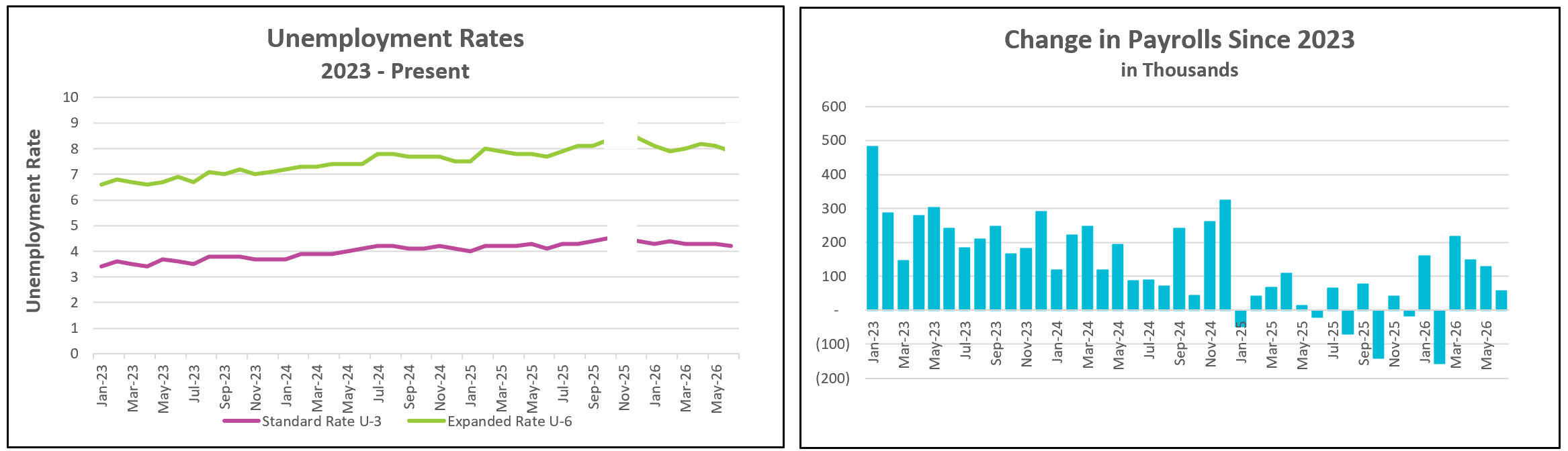
Key takeaways from the Bureau of Labor Statistics (BLS) report, The Employment Situation – June 2026, include:
In June, the U.S. economy added 57,000 jobs, a slower pace than in previous months. Payroll estimates for April and May were also lowered by a total of 74,000 jobs. Despite the softer June report, the labor market has improved compared with the second half of 2025. Employers added an average of 93,000 jobs per month during the first half of 2026, a significant turnaround from the final six months of last year, when the economy lost more jobs than it created.
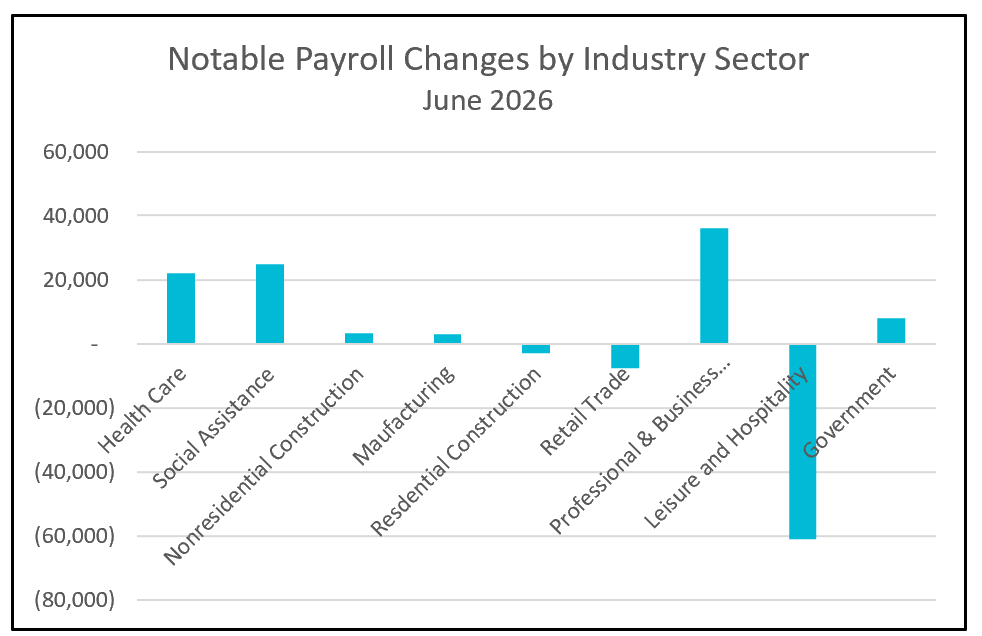
Hiring remained concentrated in health care, social services, and business services. An aging population continues to fuel demand for health care workers, while substantial investment in AI is boosting employment in areas such as commercial construction, utilities, and other professional services that support new technology infrastructure.
The largest source of weakness came from the leisure and hospitality industry, which shed 61,000 jobs in June. The decline likely followed a temporary hiring surge in May, as many businesses staffed up ahead of the World Cup. But nationally, consumers continue to feel the effects of inflation, with wage growth of 3.5% failing to keep pace with 4.2% inflation. As household budgets tighten, discretionary spending—particularly dining out—has softened, reducing demand for hospitality workers. While leisure and hospitality employment has softened across most of the country, communities hosting World Cup games are benefiting.
Although the unemployment rate declined in June, the improvement was largely due to a shrinking labor force rather than stronger hiring. Employment fell by more than 500,000 people, while the labor force declined by 720,000. The labor force participation rate dropped to 61.5%, its lowest level in more than five years, reflecting an aging population and stricter immigration policies. However, it is alarming that many prime-age workers have become discouraged, and the participation rate among that group has fallen.
Overall, the labor market appears to be in a holding pattern. Employers are hesitant to expand payrolls, yet they are also reluctant to lay off employees. As a result, unemployed workers are finding it increasingly difficult to secure new jobs. Fortunately, most economists believe that while hiring has cooled, job growth remains sufficient to keep pace with long-term labor force growth based on current demographic trends.
For policymakers at the Federal Reserve, June’s employment report is unlikely to change their policy outlook. The unemployment rate remains low, and job growth is neither weak enough to justify lower interest rates nor strong enough to suggest the economy is overheating. Instead, policymakers are likely to remain focused on bringing inflation under control, leaving interest rates unchanged or potentially raising them if inflationary pressures persist.
Attention now turns to the Bureau of Labor Statistics’ June Consumer Price Index report, scheduled for release on July 14. Higher Rock will publish its analysis shortly after the inflation data are released.